Private AI & LLM Infrastructure
AI built around your company. Not the other way around.
Give your team an AI that actually knows your business: your projects, customers, documents and procedures. It works inside the permissions you set, on infrastructure you choose, and we design it, build it, connect it and keep it running.
01The basics
In plain English
Tools like ChatGPT run on a large language model (LLM): software that reads and writes language. On its own, a model knows nothing about your company.
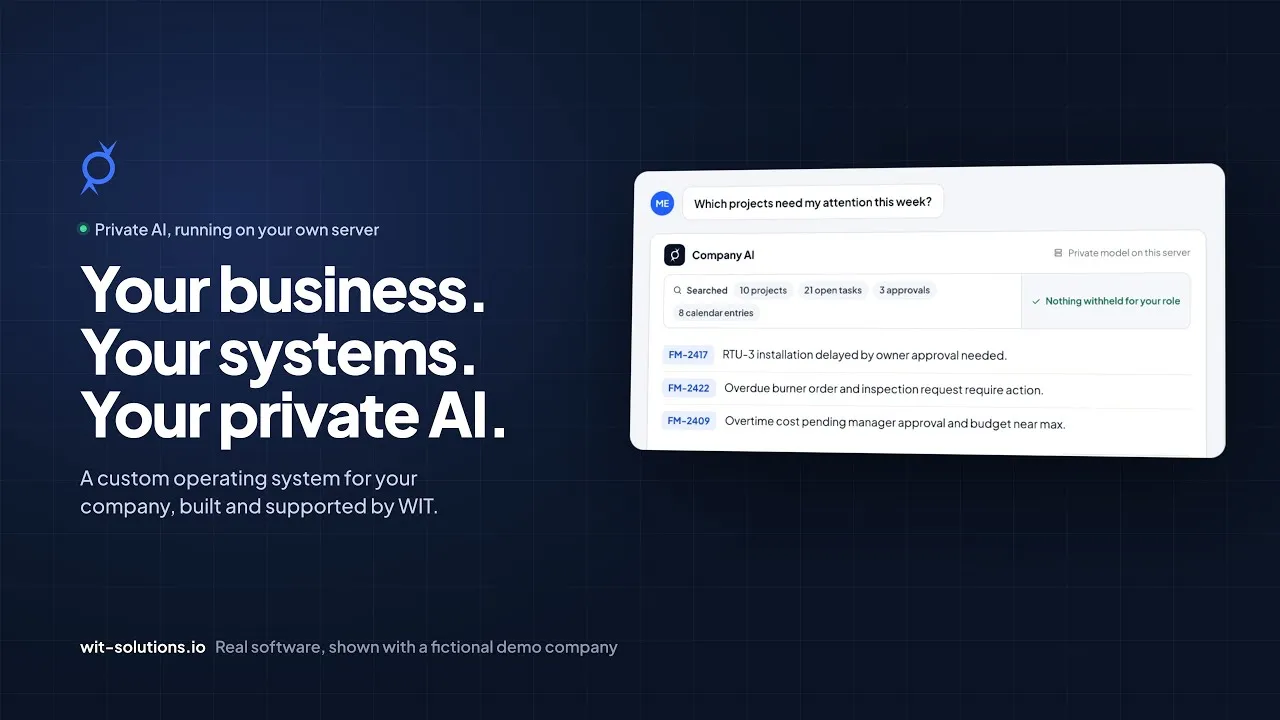
A company AI connects a model to your information (projects, customers, documents, procedures) and to the rules about who may see what. When an employee asks a question, it looks only in the places that person is allowed to see, and answers with references to where the information came from.
“Private” is not one setting. It describes four choices: who can use the AI, what it can see, where it runs, and what it is allowed to do. We help you make each choice deliberately.
- Who can use it
- What it can see
- Where it runs
- What it may do
02Know what you’re buying
Four things people mean by “company AI”
These are different products with different costs and privacy properties. Knowing which one you need is the first decision.
- 1
AI assistants using hosted models
Your tools use a model run by an AI provider, through a business account. Fastest to start and lowest upfront cost. Your prompts and documents are processed by that provider under its business terms.
- 2
Dedicated private deployments
A model runs on infrastructure dedicated to your company: a private cloud account or, where feasible, your own servers. Prompts and documents stay inside the environment you control. Higher infrastructure and maintenance cost.
- 3
Your company’s knowledge and workflows
Built on either option above: the AI searches your approved documents and systems with permission checks, follows your procedures, and can prepare actions for approval.
- 4
Fully custom-trained models
Training or fine-tuning a model on your own data. Worthwhile only in specific cases, and always a separately scoped project. Most companies get more value from options 1 to 3.
03Deployment options
Where your AI can run
Each option is a possible configuration, not a universal guarantee. Before you decide, we document exactly where your information is processed and stored.
| Option | Where the model runs | Where your data goes | Good fit when | Trade-offs |
|---|---|---|---|---|
| Approved external providers | The provider’s cloud, through a business account or API. | Sent to the provider for processing under its business terms and your account settings. | You want to start quickly, data sensitivity is moderate, and the provider’s terms are acceptable. | Least control over where processing happens. Usage costs grow with use. |
| Dedicated AI deployment | A model reserved for your company on dedicated hosted infrastructure. | Stays within that dedicated environment and the hosting provider’s terms. | You need more isolation than a shared service, without running hardware yourself. | Higher fixed cost. Capacity has to be planned. |
| Your private cloud | An open-weight or licensed model in a cloud account your company controls. | Stays in your cloud account, under your cloud provider’s agreement. | You want control over location, access and logs, and you already use a major cloud. | You pay for compute directly. Needs ongoing administration, which we can provide. |
| On-premises, where feasible | Servers at your premises or in your own data center. | Stays on hardware you own, if the whole system is configured that way. | Strict data-location requirements, or a strong preference to keep everything in-house. | Hardware cost, power, physical security and upkeep. Smaller models than the largest cloud services. |
What we build on top of any option
- Knowledge retrievalThe AI searches your approved documents and systems, and only returns what the person asking is allowed to see.
- Model adaptationInstructions, examples and, where justified, fine-tuning so answers follow your terminology and procedures.
- AutomationApproved actions such as drafting updates, filling forms or creating tasks, with a person approving anything important.
04Typical architecture
Every request passes through your rules.
This is the shape of a typical WIT company-AI system. The details change with your hosting option and the systems you connect, but the permission checks and approvals stay.
- 01EmployeesSign in with their own account and role.
- 02Secure command centerWhere they ask questions and do their work.
- 03Permission-aware AIChecks who is asking before it looks anything up.
- 04Approved knowledge & systemsOnly the sources you connected, filtered by that person’s access.
- 05Controlled actionsDrafts and tasks that a person approves before anything is sent or changed.
What that looks like for the person asking
An owner asks a plain-English question. The AI checks who is asking, looks only where they’re allowed, answers with sources, and prepares the next step for approval.
Signed in · Owner role
Which active jobs are behind schedule this week, and why?
- 1Checks who is askingConfirms the person’s identity and role before looking anything up.
- 2Looks only where they’re allowedSearches project schedules, crew logs and supplier emails this role has permission to see.
- 3Answers with sourcesSummarizes the findings and shows which records each point came from.
- 4Prepares approved actionsWhere implemented, drafts the next step and waits for a person to approve it.
3 of 14 active jobs are behind schedule:
- Maple Ridge: Permit approval delayed, 4 days behindProject schedule
- Oak Street: Shingle delivery back-ordered to ThursdaySupplier email
- Lakeview: One crew short since MondayCrew log
Draft an update to the Maple Ridge client?
05How it’s run
Deployment, data, security and cost, explained.
- Model deploymentWe select a model for the job (hosted, open-weight or licensed) and deploy it in the environment you chose, sized for your usage.
- Data handlingWe document what information the AI can reach, where it is processed, what is stored, and for how long. Sensitive sources can be left out entirely.
- Infrastructure ownershipThe environment can be set up in accounts your company owns. Third-party models and cloud services remain under their providers’ terms.
- Security boundariesThe AI runs behind your sign-in, with network and access rules that limit which systems it can reach.
- PermissionsEvery search is filtered by the asking person’s role, so the AI can’t become a way around your access rules.
- MonitoringUsage, errors, costs and answer quality are monitored, with logs of who asked what, where your configuration keeps them.
- Model updatesModels improve quickly. We test new versions against your own examples before switching, so answers don’t change without warning.
- Cost & maintenanceHosted options cost more as usage grows; private options cost more up front and need upkeep. Your proposal shows both, so you can compare.
Built for real business use
Questions about private AI
Straight answers on training, access, accuracy and cost.
AI inside a business operating systemWill our data be used to train someone else’s AI?
It depends on the option and the provider. With a private deployment, the model runs in an environment you control. With a hosted provider, we use business accounts and settings that address training use, and we show you the provider’s current terms in writing before you decide.
Can the AI see everything in our company?
Only what you connect to it, and only what the person asking is allowed to see. You can leave sensitive sources out entirely.
What happens when the AI is wrong?
It will sometimes be wrong, so we design for it: answers show where the information came from, and anything important (sending, changing or deleting) needs a person to approve it.
Can we start small?
Yes. Many companies start with one department, one set of documents and a hosted model, then move to a dedicated or private deployment once they see the value.
What does it cost to run?
Hosted models cost more as usage grows. Private deployments cost more up front and need maintenance. We estimate both for your expected usage in the proposal.
Find out what a private company AI would do for your team.
In a free Business Operations Audit we look at where your people lose time searching, retyping and answering the same questions, and which AI option fits your data, budget and IT requirements.
- Call us(740) 602-6411
- Based inColumbus & Dayton, Ohio
- Business Operations AuditFree · 60 minutes · remote